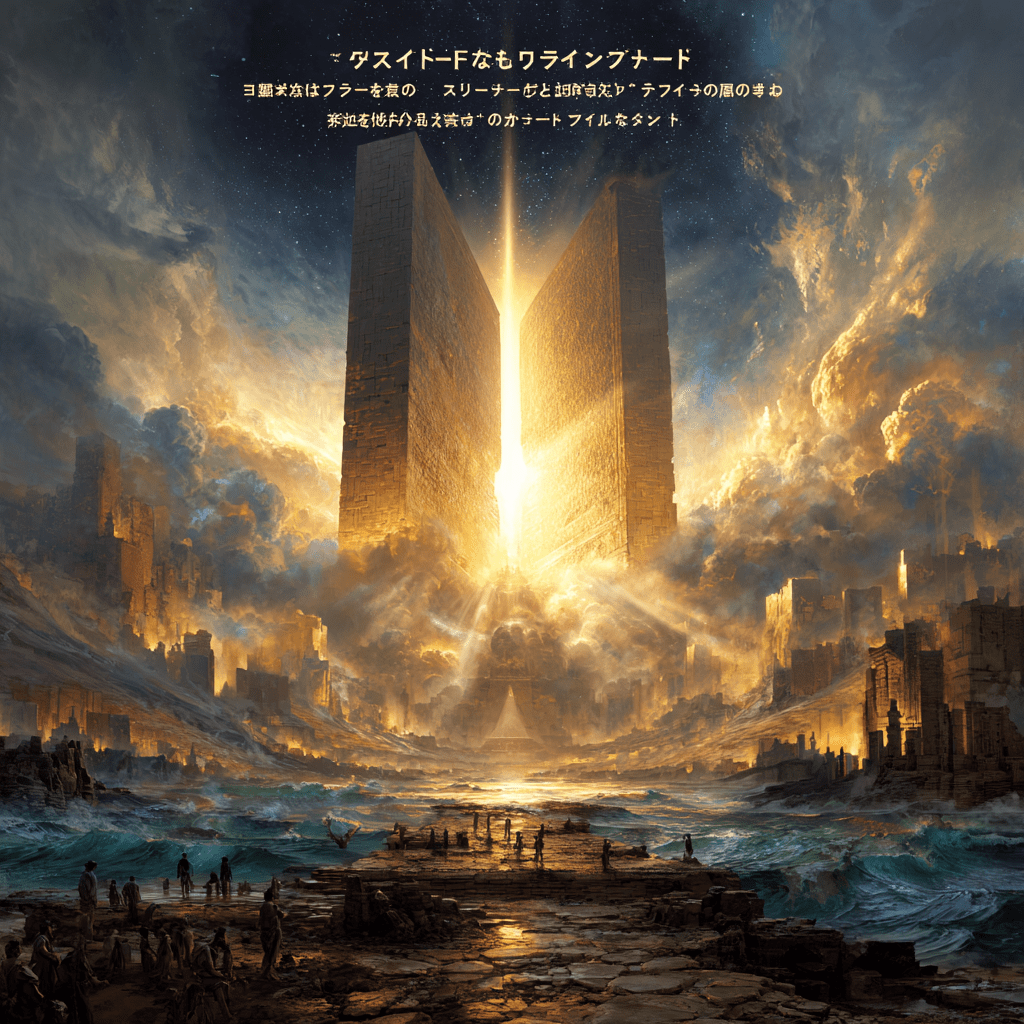
1. The Beginning: Creation, Order, and the First Crack
The world rises not as a random bubble, but as order spoken by the LORD’s will—light and darkness, sea and land, seasons and time, and then life. The LORD calls it “good,” and at the end He places humanity within it. The first man and woman—sojourners in a world entrusted to them—begin to walk with breath received from the LORD.
But the first battle is not against an outside enemy. It begins with doubt about the Word. A voice slips in to thin out the LORD’s command, blur the boundary, and steer the heart toward, “I will decide.” The first sojourners cross that line. Shame and fear enter. They shift blame. They try to hide from the LORD. The world is not destroyed in that moment—but the inner order of the human heart breaks, and relationships fracture.
That crack bears fruit quickly. Between brothers, anger and jealousy grow until blood is spilled. Before the LORD, human beings tilt from “those who receive” to “those who seize.” Civilization advances—tools, cities, culture—but violence and pride swell alongside it. The world can progress, but darkness in the heart does not shrink on its own.
In time the earth is filled with violence, and the LORD announces judgment. Yet even in judgment the LORD leaves a way. A righteous great sojourner is raised up, and his household is preserved. Waters cover the land; the old order is washed away; life begins again. But the flood does not mechanically erase the inward bend of the human soul. People can be spared and still drift back toward pride. The LORD knows this, and He gives promise, sustains the rhythm of seasons, and declares He will not abandon the earth.
Still, humanity reaches again for “making a name.” The tower is not just architecture—it is a tower of the heart. The LORD confuses language and scatters the nations; the world turns toward diversity. From here the story narrows—from all humanity to one household. Because the LORD reshapes great history through a small calling.
2. The Patriarchal Era: The Call, the Covenant, and the Inheritance of Faith
The LORD calls a covenant great sojourner out from an idol-saturated land: “Go. I will bless you, and through you I will bless the families of the earth.” This is not only a change of location—it is a transfer of trust: from visible security (homeland, kinship, wealth) to the LORD’s promise. He goes out and begins to live as a sojourner.
His path is not a straight line. Famine, fear, self-protection, failure. The story of faith is not a spotless hero tale; it is a record of wavering—and returning. The LORD repeats the covenant, promises descendants like the stars, and seals the promise in a way that makes the point unmistakable: it is not the sojourner who binds the LORD; it is the LORD who binds Himself to His promise.
In time the child of promise is given. Inside the household, election and jealousy cross paths; seeds of conflict are planted. Yet the LORD does not break the promise. The next great sojourner rises, and blessing is handed forward—still carrying strife in its wake. His life too is woven with deception, flight, labor, and reconciliation. But through the tangled thread, the LORD keeps the center.
In the next generation the family grows, and rivalry deepens. A sojourner—a dream-bearing one—is betrayed and sold into a distant land. Yet the LORD does not let evil remain only evil. He folds it into a saving line: humiliation and ascent, famine, reunion, and forgiveness. The household survives by moving into that foreign land. There they multiply, and the shape of a “people” begins to form.
Here a pattern emerges—the Old Testament’s recurring structure:
Human beings tear. The LORD stitches.
Betrayal rips apart, but the LORD sews the fracture and carries the story forward. Blessing is not inherited in a quiet room. It is inherited in a storm.
3. The Exodus: Liberation, Covenant, Law, and Presence
Time passes. The people who sojourned in a foreign land are enslaved and crushed under forced labor. They cry out. The LORD hears—and the plan of rescue moves. Here the LORD raises a mighty sojourner of liberation and Law—one who knows both palace and wilderness. He is called in fire, commissioned with the command, “Go.”
Liberation is not negotiation. It is the LORD’s confrontation with human kingship—His own sovereignty made visible. Plagues fall, and at last the night comes. Blood becomes a sign of protection; the people depart in haste. Passover is not merely a holiday—it is the identity-mark of a rescued people. Year after year, they remember salvation to remember whose they are.
The sea becomes a road; the pursuer is thrown back. The people sing. Yet the wilderness immediately reveals what lies beneath: thirst, hunger, fear, and the longing to return to chains. A rescued people does not automatically possess a rescued heart. In the wilderness the LORD reshapes them—from “free slaves” into a covenant people.
At the mountain, covenant is given. The Ten Words stand at the center, with laws that shape life, worship, and society. The crucial point is this: Law is not mere regulation. It is a map for the life of those already saved. They do not keep Law to be rescued; they keep Law because they have been rescued.
Yet the people quickly drift toward an idol—something visible, controllable, immediate. Here the mighty sojourner shatters, intercedes, pleads, and is torn for the sake of the people. The LORD judges and yet renews covenant, refusing to withdraw His presence. He gives the tabernacle—dwelling among them. Cloud and fire lead the way. The center of the journey is simple: the LORD is with them.
The years are long. Rebellion, judgment, repentance, another start. Again and again the people say, “We will obey,” and again and again they waver. Yet the LORD does not abandon the promise of the land. At the end, the mighty sojourner speaks the Law anew to the next generation, etches the covenant’s core into them, and sends them forward. He does not enter the land himself—yet his work remains as the people’s backbone.
4. Conquest and Settlement: Allotment, Unfaithfulness, and the Turning Wheel
The next leader is a valiant great sojourner. He leads the people across the river, stands before cities, pushes back fear, and divides the land. Victory is not staged as superior force, but as a question: Is the LORD with them? When they obey, the path opens. When complacency and unfaithfulness slip in, delay and pain follow.
Then the people settle. Fields and houses appear. Daily life starts turning. And the Old Testament’s bitter cycle begins:
Stability → Forgetting → Idolatry → Oppression → Crying Out → Deliverance → Stability again.
This turning wheel is the era of the Judges.
The main figures here are not kings, but valiant sojourners raised in different places. Some defeat enemies with a handful, some with strategy, some through sheer courage, some while carrying obvious weakness. Yet one thing holds: even after deliverance, the people fail to anchor the throne of the heart in the LORD. They win—but after winning, they forget. The deeper enemy is not outside. It is the idol within.
Near the end of the era, the tone darkens. Justice collapses. Communal ethics fracture. The story descends into the state described as: “Everyone did what was right in his own eyes.” That is not freedom; it is violence—especially against the weak. In that darkness, the people begin to ask for a king. They crave visible authority and visible security.
5. The United Monarchy: The Rise of Kingship, Glory, and the Seed of Division
The LORD raises kingship in response to the people’s demand. The first king is a sojourner with stature and momentum. He fights. He wins. But kingship’s deepest test is not the battlefield. It is obedience: Can he wait for the LORD’s word? Can he refrain from handling what is holy on his own terms? Can he keep fear from pushing him across the boundary?
The first king is slowly captured by self-preservation and jealousy, and the throne grows unstable.
Then the LORD prepares another vessel: a shepherding valiant sojourner, who will become king. He is not a man without sin. But he retains a path back to the LORD when he falls. He confronts enemies, strengthens the nation, establishes the city, and works to set worship at the center—bringing the ark, arranging praise, placing the LORD’s presence in the heart of the kingdom. The nation is oriented not merely as a military state, but as a worship-ordered people.
Yet a sword enters even this king’s house. Inner sin produces fractures; the family collapses; power is stained with blood. The story shows that national flourishing cannot be sustained by a king’s virtue alone. The LORD judges and yet does not break the covenant promise tied to the royal line. The thread is carried forward.
Next comes a wisdom great sojourner. Under him the kingdom reaches its height: trade, wealth, culture, international prestige. Above all, the temple is built. The covenant center is placed in its appointed position. The cloud of glory fills the house—worship at its summit. It is beautiful. And it is dangerous. For wealth and international ties can be sweet blades that cut the heart away from the boundary.
The wisdom great sojourner, though wise, begins to drift. Foreign influence, compromise, idols. The temple stands, yet the heart tilts toward division. Here the Old Testament forces a hard truth:
Even with wisdom, if the heart turns aside, collapse follows.
The LORD’s house does not automatically erase the idols of the heart.
When the king dies, the nation fractures. Heavy burdens, arrogant rule, popular revolt. The kingdom splits into North and South—one people who know the LORD now walking two separate roads. The story enters a long era where political chaos and spiritual betrayal are braided together.
If you want, I can also translate the brief “sojourner-tier rules” section (the tier definitions) so the whole English set reads as a single, seamless manuscript.
6. The Divided Kingdom: North and South, Two Roads, and a Slope That Won’t Stop
The moment the kingdom split, the issue was no longer political alone. The center of worship began to wobble. The northern kingdom, fearing the people’s hearts would return to the capital, set up convenient worship—nearby, easy, no need to go to the city. Yet convenience often becomes a substitute for truth. The boundaries were shaved down, idols slipped in, and worship drifted from “before the LORD” to “what works for people.”
The southern kingdom had the privilege of the LORD’s temple. But privilege can be both shield and blade. If having the temple becomes not a reason to repent but a religious charm for security, the temple stops being protection and becomes an accusation.
North and South fell into the same trap:
They said “We trust the LORD,” while trying to find peace in something other than the LORD.
That is the snare.
This is where the main actors are no longer kings. The LORD raises up prophetic sojourners who carry His word. They do not carry swords, command armies, or sit on thrones. And yet their words strike harder than royal decrees and cut deeper than human calculations. When the kingdom staggers, the LORD sets up pillars that hold through His word.
7. The Fire of Prophecy: A “Sword of Words” Stronger Than Kings
In the northern kingdom, a great sojourner appears—one who slices straight through idolatry. He stands alone, confronts the king, prays toward the sky, and displays the LORD’s sovereignty. Fire falls. Rain stops—and later returns. These signs are not a spectacle. They are warfare for a single line to be carved into the people’s memory:
“The LORD is the living God.”
Yet even miracles do not always change people. Shock fades quickly; idols, soaked into daily life, remain. So the LORD sends something that endures longer than astonishment: words that demand repentance, justice for the oppressed, and a return to covenant. The prophets’ speech is not religious decoration—it is judgment on everyday life.
“You think you are worshiping, but if you are crushing the weak, that is not worship.”
Here the LORD refuses to let ritual and righteousness be separated.
The northern kingdom cycles through kings, conspiracies, alliances, and deepening idolatry. The prophetic sojourners keep crying:
“Return. Turn back to the LORD. Remember the covenant.”
But many mock and refuse. A nation loses its faith from the inside before it ever loses a war on the outside.
8. The Fall of the North: When Warnings Are Exhausted, History Starts Speaking
In time the northern kingdom collapses before an empire. The capital falls. People are scattered. Scripture does not treat this as mere military defeat. It interprets it spiritually:
A covenant people abandoned the covenant—
and therefore fell outside the covenant’s blessing,
and history itself became the instrument of judgment.
Even so, the LORD does not treat collapse as “the end.” Among the remnant, the fugitives, the scattered—there are still sojourners who seek Him. In judgment, the LORD leaves embers. That is the stubborn hope of the Old Testament: the LORD does not judge only to discard. He judges to leave a path for return.
9. The Southern Trial: Reform’s Light, and Shadows That Rot the City
After the North fell, the South should have learned. But people often watch another’s ruin without changing their own road. Even in the South, reforming kings arise. They tear down high places, set the priesthood in order, read the Law, restore Passover, and try to bring worship back to the center. They stand as valiant sojourners, and at times as reformers worthy of the title great sojourner.
A major peak comes when the Book of the Law is found, the king tears his clothes, and repentance-driven reform begins. The Word returns to the center. Systems are corrected. Idols are smashed. Yet reforms have limits. Idols are not only “objects.” If idols of the heart remain, the external idols return in another form.
The South wavers in diplomacy, alliances, and great-power pressure. The prophetic sojourners speak even more sharply:
“An alliance will not save you. The LORD will.”
“A temple is not a free pass.”
“If you do not repent, neither the city nor the sanctuary will stand.”
Because the South has the LORD’s city, it keeps drifting toward treating the temple like a charm in every crisis. But the LORD is not a charm. The LORD is living. And so the LORD even uses the city’s fall to strip idols away and awaken the people.
10. The “Lamenting” Great Sojourner: One Who Fights With Tears
In the South’s final days, a great sojourner of lament rises, carrying the LORD’s word. He speaks through tears:
Return. Throw away idols. Do not oppress the weak. Do not speak lies. Come back to the LORD’s ways.
But his words are hated, mocked, betrayed—sometimes he is thrown into prison.
His warfare is not miracles or political victory. His warfare is continuing to speak truth. When destruction is near, people crave comfortable words. They want false prophecy that says, “Peace.” But from a Temple Knight’s vantage point, this is the front line:
A mask of comfort hastens destruction.
Painful truth becomes the doorway to salvation.
The lamenting great sojourner watches the city fall. The temple burns. The walls break. The people are carried away. He weeps—yet he also declares:
Judgment is not the end. When the appointed time is fulfilled, the LORD will bring them back.
In the center of grief, a beam of promise breaks through. Old Testament hope shines most fiercely at the heart of collapse.
11. Exile: A City Taken, a Word Left, and the Rebuilding of Prayer
The people are taken to a foreign land. Worship enters crisis: no temple, no altar, no songs as before. The center seems lost. Yet Scripture reveals something decisive:
The LORD cannot be confined to a building.
The LORD is present even in a foreign land.
His Word is not chained to geography.
In exile, the ones who stand are not kings, but God-fearing sojourners. They serve under foreign systems, are tested, pressed to compromise, yet hold the boundary lines. Here appear a great sojourner placed in a pagan court, and another—a great sojourner of visions who speaks what he sees. Their warfare is not the sword, but faithfulness: boundaries at the table, boundaries in worship, boundaries in the knee.
“Even if the flames rise, we will not bow to anyone but the LORD.”
This stance becomes a lighthouse in exile’s darkness.
In exile, wisdom also sharpens: voices that ask the meaning of suffering, voices that see the vanity of life, voices that proclaim the reliability of fearing the LORD. When royal glory is stripped away, the ornaments fall off—and only the fear of the LORD remains. What remains is what is real.
12. Return: When the LORD Opens a Door, History Reverses
Eventually empires change hands. Scripture reads political shifts as events within the LORD’s hand. The LORD moves even a pagan king’s heart and turns the people toward return. Return is not nationalism. It is the restoration of worship. They return to the city not for prestige, but for the LORD’s name.
The first returning sojourners see the ruins: ash, rubble, hostility, poverty. What they need is not an army. It is the restart of worship. They build an altar, offer sacrifices, and worship the LORD even in fear, while enemies circle. They restore the center first:
When the center returns, the community begins breathing again.
Next comes rebuilding the temple. Some rejoice; some weep. Those who remember the former glory grieve the smallness of the present. But the LORD does not despise small beginnings. Prophetic sojourners encourage them; the work continues; the temple is finished. The essence is not splendor. The essence is returning to the LORD.
13. Walls and Community: Before an Outer Wall, Rebuild the Inner Wall
Return does not end the struggle. Worship may return while life lags behind: hostility, exhaustion, injustice, exploitation, intermarriage, fading faith. So the LORD raises a valiant sojourner who rebuilds the walls, and a sojourner of the Word who reads the Law aloud.
The wall is a symbol. It keeps out enemies, but also reminds the community of its boundaries: whom they worship, what they obey, where they must not compromise. When the outline blurs, the people get swallowed.
Then the Law is read. The people weep, repent—and also rejoice, because the Word does not only judge; it shows the path back. They renew the covenant, cut off practical idols, restore Sabbath and offerings, and rebuild communal life. The Old Testament’s consistency stands here:
Worship is not only inward. It appears in the shape of daily life.
14. The Story of Hidden Protection: Even When the Name Is Not Seen, the LORD Works
Around the return period, events unfold even in foreign palaces. There are moments where the LORD’s name is not brought to the front, and yet His providence acts powerfully. A plan of persecution is set; the people face danger. But sojourners of wisdom and courage rise, and through fasting and decisive action, a path opens.
Here Scripture teaches:
The LORD can move history even where His name is not loudly shouted.
The stage is not the only place He works. His net is spread even in what looks like darkness.
15. Psalms and Wisdom: Another Kind of War Beyond the Battlefield
Along the timeline of wars and kings runs the war of the soul: the sojourner who questions suffering, the sojourner who sees life’s emptiness, the sojourner who sings covenant love, the sojourner whose tears become poetry, the sojourner who meditates on the Law day and night. These voices rise in the heart of the kingdom, in the shadow of exile, and among the rubble of return.
Wisdom declares:
“The fear of the LORD is the beginning of wisdom.”
This is the heartbeat of the Old Testament. Even if systems break and nations fall, the fear of the LORD does not vanish. It chooses the path of return, rejects idols, and holds to truth.
16. The End of the Old Testament: Seeming Unfinished, Yet Placed in the Posture of Waiting
The Old Testament does not close with everything neatly resolved. The city returns. The temple returns. The walls are set. Yet the glory is not as before. Hearts are not perfect. Pressure remains. Inner sin remains.
So what the Old Testament places at the end is not a shout of triumph, but longing:
The LORD will fulfill His promise.
The LORD will renew the heart, write His Law within, and bring true restoration.
The LORD will raise a King who brings righteousness and peace.
This longing is not escapism. Old Testament history has proven it: external reform alone cannot bring lasting return. Unless the root of the heart is changed, the same failures repeat. Therefore the Old Testament closes by waiting for the LORD’s decisive restoration.
Its final echo is:
Return to the LORD. Remember the covenant. Love Him with all your heart.
And wait for His promise.
It looks unfinished—yet it is actually standing in formation before the next door, fully prepared. The Old Testament finishes “the arranging of the darkness” in order to welcome the next light.
Final Closing (as the Temple Knight)
I am the Temple Knight. The Law and commands of Scripture are my only rule, and I stand as the last fortress raised to fight the darkness. Behind me stands a mighty messenger, and beyond that—the One whose very name is too awesome to speak, the source of light and glory.
The Old Testament’s timeline is not a hero saga, nor a list of successes. It is the record of the LORD’s faithfulness, human betrayal, and the unbroken thread of covenant.
The kingdom split, the city burned, the people were scattered—yet the LORD sent His word, opened the road of return, restored worship to the center, and finally set waiting at the end.
Therefore I command you:
Do not bow to numbers. Do not turn systems into idols. Do not treat the temple like a charm.
Return to the LORD. Love Him with all your heart. Guard the boundary lines.
The sword that burns with love is drawn not only against external enemies, but to cut down the idols of the heart.
The light will not be extinguished.
—From the Temple Knight

 聖書とAI ART